Female | Fimeiru
2005
This was the official website for the 2005 Japanese film, Female, also known as Fimeiru.
Content is from other sources since the archived pages of this site yielded nothing.
Also known as: Fimeiru
Language: Japanese
Subtitle: English (Soft-subbed)
Release Date: 2005
Genre: Drama / Mature 18+
Synopsis:
Five short films adapted from five novels by female authors.

Female is comprised of five shorts:
“Momo”(Peaches) is about a 29yr old woman who goes back to her hometown for a funeral many years after moving away. The woman was involved in a scandal with her teacher when she was young, when people found out she and her family moved to Tokyo.
“Taiyô no mieru basho made” (Drive Until you See the Sun) is about an old hostess who gets robbed inside a taxi by a young woman at knife point. The taxi is being driven by another woman, she has also been robbed and is being forced to drive around the city.
“Yoru no shitasaki” (Licking Nights) is about a female factory worker who keeps getting hit on by her superior, but she does not like him she likes someone in the accounting department. She agrees to go on a date with her superior if he agrees to give her a vacation first. On her vaction she buys a strange object which allows her to control her dreams.
“Megami no kakato” (Heels of the Muse) tells the story of a boy who tutors his girlfriend at her house but, is obsessed with her attractive mom.
“Tamamushi” (Jewel Beetle) is a short about a middle aged woman who lives in a small village. She has no job but, is supported by a rich old man in exchange for sex.
Starring:
- Kyoko Hasegawa
- Chihiro Otsuka
- Saki Takaoka
- Nene Otsuka
- Eri Ishida

TOMATOMETER AUDIENCE 50%
IMDb Review
127 IMDb users have given a weighted average vote of 5.9 / 10
an impressive movie, 11 March 2008
*********** Author: Paul Nanu from Romania
I think this movie can really make you think about the endless twists life can take when you least expect... 5 episodes in one single movie, every time new characters reveal their inner hidden true self. A good selection of Japanese directors. Most of the time, the characters meet each other, remember thing they thought lost forever, becoming friends and not least becoming aware of the power of seduction of the Other. Of course you have to be a fan of Japanese cinema in order to better perceive the selected short movies. i must say that i love this title because it made me somehow ask myself the questions implied by the movie itself. Why am I always so easily distracted? I've been working on a casino promotion website and as a result I'm seeing updated slots usa at online-casino-party.co promotions in my dreams. I even started playing online slots when I'm in the US with my partner. And this film brings back the vulnerable state of mind that is so beautiful and yet so sad. Although you can 't watch this movie as a regular movie, and the stories not seem to be related, i couldn't stop till the end, because it makes you wonder what story is going to be next, what dramas are in line to be presented.
+++
Female is comprised of five shorts. "Momo", based on a story by Kaoruko Himeno, was directed by Tetsuo Shinohara and stars Kyoko Hasegawa (Hasegawa Kyouko).
Kyoko Hasegawa was born on July 22, 1978 in Chiba, Japan. She is an actress, known for Three... Extremes (2004), Nanayo (2008) and Rain Fall (2009). She has been married to Haruichi Shindo since October 23, 2008. Haruichi Shindo isuone of the members of the Japanese rock band Porno Graffitti. On May 30, 2009 she gave birth to a baby boy. On January 25, 2012 she gave birth to a baby girl.
+++
"Taiyo no mieru basho made", based on a story by Yuzuki Muroi (Muroi Yuduki), was directed by Ryuichi Hiroki (Hiroki Ryuuichi) and stars Chihiro Otsuka (Ootsuka Chihiro).
Yuzuki Muroi is a Japanese novelist, essayist, and tarento represented by O.K. Production
Chihiro Otsuka (Otsuka Chihiro) (born March 12, 1986) is a Japanese actress. She has appeared in:
- Dark Water (2002)
- Godzilla: Tokyo S.O.S. (2003)
- Be with You (Ima, ai ni yukimasu) (2004)
- Godzilla: Final Wars (2004)
- Female (2005)
- Radiance (2017)

+++
"Yoru no shitasaki", based on a story by Kei Yuikawa, was directed by Suzuki Matsuo and stars Saki Takaoka.
Suzuki Matsuo is a Japanese theatre director, actor, novelist, and screenwriter. Born on December 15, 1962 in Kitakyushu, Japan as Katsuyuki Matsuo, he is an actor and writer, known for Ichi the Killer (2001), Shin Godzilla (2016) and Botanical Life of Verandar (2014). He won the Kishida Prize for Drama in 1997 for Fanki! Uchu wa mieru tokoro made shika nai. In addition to acting and directing, he also writes, and won the Japan Academy Prize for Screenplay of the Year in 2008 for Tokyo Tower: Mom and Me, and Sometimes Dad.
Saki Takaoka is a Japanese actress. Her uncle is the jazz pianist YÅsuke Yamashita. She won the award for best actress at the 19th Hochi Film Award for Crest of Betrayal
+++
"Megami no kakato", based on a story by Asa Nonami, was directed by Miwa Nishikawa and stars Nene Otsuka (Ootsuka Nene).
Nonami Asa is a Japanese crime fiction and horror writer. She is a member of the Mystery Writers of Japan. Nonami attended Waseda University where she studied Sociology but dropped out to take a job at an advertising agency. She became a published author in 1988 winning the Japanese Mystery and Suspense Award (Nihon Suiri Sasupensu Taisho): Kofuku na Choshoku (A Happy Breakfast)
Nene Otsuka is a Japanese actress. She starred in Masahiro Kobayashi's film Bashing, which was screened in competition at the 2005 Cannes Film Festival.
+++
"Tamamushi", based on a story by Mariko Koike, was directed by Shin'ya Tsukamoto and stars Eri Ishida.
Shinya Tsukamoto is a Japanese film director and actor with a considerable cult following both domestically and abroad, best known for the body horror/cyberpunk films Tetsuo: The Iron Man and Tetsuo II: Body Hammer.
Eri Ishida is a Japanese actress. She won the award for best supporting actress at the 9th Yokohama Film Festival for ChÅchin and at the 13th Hochi Film Award for A Chaos of Flowers, Hope and Pain and Wuthering Heights.
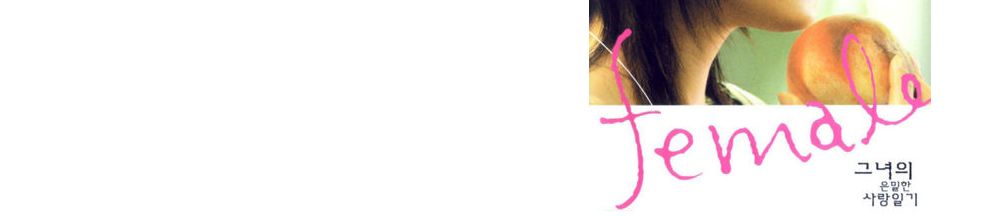
More Background On Female-Movie.com
Female-Movie.com was the official website associated with Female (female / フィーメイル), an unusual 2005 Japanese anthology film built around stories about women, sexuality, desire, memory, vulnerability, and relationships. Although the original promotional website is no longer functioning in its original form and surviving archived material is limited, the domain remains connected to a distinctive project in early-2000s Japanese cinema.
Rather than presenting a single continuous story, Female brought together five short films. Each was based on a work by a different female Japanese author and directed by a different filmmaker. The resulting 118-minute feature combined five sets of writers, directors, performers, characters, and visual approaches around a common interest in women and eros.
The project involved an impressive group of Japanese filmmakers: Tetsuo Shinohara, Ryuichi Hiroki, Suzuki Matsuo, Miwa Nishikawa, and Shinya Tsukamoto. The source authors were Kaoruko Himeno, Yuzuki Muroi, Kei Yuikawa, Asa Nonami, and Mariko Koike.
For visitors encountering Female-Movie.com years after the film's release, the significance of the domain therefore extends beyond a discontinued movie website. It represents the surviving digital identity of an ambitious collaborative film project that assembled notable figures from Japanese literature and cinema.
The Film Behind Female-Movie.com
Female was produced in Japan and released theatrically there on May 14, 2005. It runs approximately 118 minutes and was exhibited on 35mm. Contemporary Japanese listings classified it as an R-18 film, reflecting its adult subject matter and sexual content.
The movie was conceived as a female-centered variation on the Jam Films short-film anthology concept. Instead of simply assembling unrelated shorts, the filmmakers began with works written by five popular female authors around the theme of "woman." The adaptations then allowed five directors to interpret those works in markedly different ways.
This structure is central to understanding the film. Female is not simply a movie with five female protagonists. It is a deliberate collision between literature and cinema: five writers supplying source stories and five filmmakers translating those stories into images.
Contemporary Japanese coverage emphasized eros as an important connecting idea. But the individual directors approached that concept differently. Depending on the segment, eroticism could be nostalgic, threatening, comic, surreal, uncomfortable, transactional, or psychologically complicated.
That variety helps explain both the film's appeal and its divisiveness. Someone expecting a conventional feature with a single protagonist and narrative arc may find Female fragmented. Someone interested in anthology cinema, however, gets five compact interpretations of a shared subject.
Five Stories, Five Directors
The first segment, "Momo" ("Peaches"), was adapted from a story by Kaoruko Himeno and directed by Tetsuo Shinohara. Kyoko Hasegawa plays Junko Morioka, a woman returning to her hometown for the funeral of a former teacher.
The return forces Junko to confront memories of her adolescence and a scandalous relationship from her past. The story uses memory, sexuality and the physical imagery of peaches to connect adulthood with experiences that the protagonist has never entirely left behind.
Shinohara told the Japanese press at the time that he initially had difficulty understanding the source story and read another of Himeno's works to better grasp the author. His comments also drew attention to the sensual imagery surrounding Hasegawa eating a peach, illustrating the deliberately physical treatment of the anthology's erotic theme.
The second story, "Taiyo no Mieru Basho Made" ("Drive Until You See the Sun"), was adapted from Yuzuki Muroi and directed by Ryuichi Hiroki.
Its premise is substantially darker. A young woman attempts to rob an older hostess in a taxi, while the female taxi driver is herself caught in the situation. Three women of different backgrounds are placed together in a confined and dangerous environment.
Hiroki was already an established filmmaker, known for movies including Vibrator. His segment provides a useful example of how broadly Female interpreted its central theme. Not every story is simply a romance or conventional erotic drama. Female relationships, fear, survival, social position and unexpected connections also matter.
The principal performers in this segment include Chihiro Otsuka, Mitsuko Ishii and Hairi Katagiri.
"Licking Nights": Desire, Work and Fantasy
The third segment, "Yoru no Shitasaki," commonly translated as "Licking Nights," comes from a story by Kei Yuikawa and was directed by Suzuki Matsuo.
Saki Takaoka stars as Masako Kihara, a factory worker dealing with the unwanted attention of her superior while being attracted to another man. She negotiates for vacation time and travels alone to a tropical destination, where she obtains a strange incense burner associated with the ability to dream about the person one desires.
The story consequently moves between workplace sexual politics, fantasy, comedy and eroticism.
Matsuo was particularly candid about the erotic ambitions of his contribution when the directors discussed the film around its release. He had previously directed Otakus in Love (Koi no Mon) and approached Female as an opportunity to explore eros more directly on screen.
The result reportedly contained more love-scene material than the other segments. Yet its sexual encounters are not presented simply as conventional romantic fulfillment. Emotional distance remains an important part of the encounters, consistent with the anthology's broader interest in the difference between desire and genuine connection.
Miwa Nishikawa's "Heels of the Muse"
The fourth segment, "Megami no Kakato" ("Heels of the Muse"), was based on a story by Asa Nonami and directed by Miwa Nishikawa.
Its perspective is particularly interesting because it partially reverses the expected point of view. A young man becomes sexually fascinated by the mother of the girl he is tutoring or seeing. Nene Otsuka plays the object of his fascination, while Naoyuki Morita plays the adolescent boy.
Nishikawa reportedly found the project's eros theme challenging at first and decided that adolescent sexual awakening provided a way for her to approach it. She was interested in the contrast between an idealized, almost unreachable female body and more ordinary physical reality.
That makes "Heels of the Muse" relevant to the anthology's larger project. Female sexuality is not presented only from a woman's direct subjective perspective. The film also examines how femininity is observed, imagined, fetishized and constructed by others.
Nishikawa would become an increasingly prominent Japanese filmmaker, making this relatively early contribution particularly interesting in retrospect.
Shinya Tsukamoto's "Jewel Beetle"
The final narrative, "Tamamushi" ("Jewel Beetle"), was adapted from a story by Mariko Koike and directed by Shinya Tsukamoto.
Tsukamoto is internationally recognized for the extraordinary Tetsuo: The Iron Man and other visually intense films. His participation gives Female a direct connection to one of the best-known cult filmmakers to emerge from modern Japanese cinema.
Eri Ishida stars as a middle-aged woman living in an isolated house and supported by an older man, played by Kaoru Kobayashi. Their relationship has an explicitly transactional sexual dimension. The situation changes when the older man arrives with a younger man, played by Ryo Kase.
The episode's imagery includes the woman dressing in a pink ballerina costume and performing for the men, a scene that can be read simultaneously as theatrical, erotic, degrading, strange and darkly comic.
Tsukamoto explained that he connected Koike's protagonist with an erotic female character he had already imagined named Memeko Kaneda. That allowed him to interpret the source material through his own creative preoccupations, depicting a woman moving emotionally and sexually between two men.
The segment demonstrates one of Female's most intriguing characteristics: the directors were not simply anonymous technicians illustrating short stories. Each was invited to filter the source material through an identifiable filmmaking personality.
Cast and Creative Talent
The principal actresses across the anthology include Kyoko Hasegawa, Chihiro Otsuka, Saki Takaoka, Nene Otsuka and Eri Ishida.
Other performers include Hiroyuki Ikeuchi, Hairi Katagiri, Mitsuko Ishii, Naoyuki Morita, Ryo Kase and Kaoru Kobayashi.
The literary side of the project was equally important. The five stories originated with Kaoruko Himeno, Yuzuki Muroi, Kei Yuikawa, Asa Nonami and Mariko Koike, giving the production a deliberate connection to contemporary Japanese women's writing.
The Japan Film Database credits Shinya Kawai as producer and lists Sega, Amuse, Micott & Basara, Japan Digital Contents and mobcast among the production companies. Contemporary Japanese film listings identify Toshiba Entertainment among the companies involved in theatrical distribution.
The theme-song credits include Sowelu, HI-D and JUN 4 SHOT.
Rather than revolving around one marquee filmmaker or actor, Female sold itself through accumulation: five writers, five directors, numerous recognizable performers and five different interpretations of its central idea.
Female as Part of the Jam Films Tradition
One of the most useful ways to place Female historically is through its relationship to the Jam Films series.
The Jam Films concept used short-form filmmaking to bring together different directors and creative approaches. Female was promoted as a new variation on that format, concentrating specifically on women and adapting newly written works by female authors.
This helps explain why the movie feels more like a curated collection than a conventional feature.
Anthology films inherently involve trade-offs. A director has only a fraction of normal feature length in which to establish characters, conflict and atmosphere. That can limit character development, but it can also encourage experimentation.
In Female, the structure creates something resembling a cinematic short-story collection. Viewers finish one emotional and visual world and immediately enter another.
The common theme prevents the five works from becoming completely arbitrary. Together they examine sexual memory, coercion, fantasy, attraction, economic dependence, age, power and the ways women are perceived by themselves and by others.
Release, Festivals and International Exposure
Female was theatrically released in Japan on May 14, 2005.
The Japan Film Database records the film as appearing at the 29th Hong Kong International Film Festival and the 9th Puchon International Fantastic Film Festival in South Korea. Its international festival exposure is significant because anthology films of this kind often depend on festivals and specialist audiences to build awareness outside their domestic markets.
Some online accounts have loosely connected Female with Cannes, but this should be treated carefully. A stronger Cannes connection involves actress Nene Otsuka, who appeared in Masahiro Kobayashi's Bashing, a different Japanese film that competed at the 2005 Cannes Film Festival. Available authoritative listings for Female specifically identify Hong Kong and Puchon rather than Cannes.
The distinction matters when reconstructing the history of a film whose original promotional website has largely disappeared.
Reviews and Audience Response
Female never became a mass-market international hit, but it developed enough of a footprint to remain catalogued and discussed decades later.
Reception has varied considerably by platform and audience. Japanese movie site Filmarks has displayed an average around 3.0 out of 5, while AllCinema has shown a stronger user rating based on a relatively small voting pool. Rotten Tomatoes lists a 50 percent audience score based on more than 50 ratings, while IMDb has accumulated fewer than 200 ratings and places the film in the mid-5 range out of 10.
Those numbers should not be overinterpreted. The samples are small compared with mainstream films, and ratings can change over time. They are more useful as evidence of the film's niche status than as a definitive verdict on its quality.
International critical response included a review by Russell Edwards in Variety. The film's combination of modern womanhood, eroticism and prominent Japanese filmmakers gave international critics an obvious point of entry even though its anthology structure and adult subject matter limited its commercial reach.
The diversity of its five episodes also makes simple ratings somewhat misleading. A viewer may strongly admire Tsukamoto's "Jewel Beetle," for example, while being much less interested in another segment. Anthologies virtually invite audiences to choose favorites.
What Female-Movie.com Was Designed to Accomplish
Female-Movie.com existed during an era when dedicated domains were a standard component of movie marketing.
A film could have its own web identity rather than existing primarily as a page inside a streaming platform, studio site or social network. The domain name itself was straightforward and internationally legible: "Female" plus "Movie."
Its fundamental purpose would have been promotional—establishing an official online destination associated with the film and its release.
The surviving historical record for the site's actual pages is poor, so detailed claims about its original menus, design, interactive features or exact page structure cannot be made reliably. This is an important distinction. Information about the movie survives extensively; information about precisely what visitors saw on Female-Movie.com is much harder to reconstruct.
The domain nevertheless would have served an obvious branding role by connecting publicity for the anthology with a memorable standalone address.
Location and Geographic Context
Unlike a theater, restaurant, gallery or other physical destination, Female-Movie.com did not represent a visitor location. Its geographic identity came from the Japanese film industry behind it.
Female was a Japanese production, made in Japanese and theatrically distributed in Japan. The Japan Film Database's historical international contact information connects rights handling with Sega in Tokyo.
The film's festival appearances broadened that footprint into Hong Kong and South Korea, while later databases, reviews, subtitled releases and online film communities introduced it to audiences farther abroad.
Female-Movie.com can therefore be understood as a digital bridge between a specifically Japanese production and an international audience capable of discovering the movie online.
Popularity and the Website's Digital Legacy
There is no reliable evidence that Female-Movie.com was ever a high-traffic website on the scale of a major international studio release.
That would not have been necessary for it to serve its purpose.
A specialist Japanese anthology released in 2005 had a relatively narrow natural audience. Its potential visitors included Japanese moviegoers, followers of the five directors, readers of the five authors, fans of individual cast members, festival audiences and international enthusiasts of Japanese cinema.
Today, the movie has a modest but persistent digital footprint. It remains catalogued by major film databases and Japanese movie sites, and viewers continue to record ratings and reviews.
That persistence is arguably more meaningful than raw popularity. Many promotional websites for movies released in the early 2000s have vanished completely. When the original website disappears, databases, reviews, festival records and archived references become the pieces from which its history must be reconstructed.
Awards and Recognition
It is important to distinguish the prestige of Female's participants from awards actually won by the anthology.
Author Asa Nonami, director Suzuki Matsuo, actress Saki Takaoka, actress Eri Ishida and other participants have received significant recognition during their individual careers. The directors include filmmakers with substantial reputations inside and outside Japan.
Those honors should not automatically be presented as awards for Female itself.
The strongest documented recognition for the movie as a whole is its selection for international festival programming, including the Hong Kong and Puchon festivals.
This distinction makes the history more accurate while also illustrating why the project attracted attention: its appeal came partly from assembling already notable creative personalities in one production.
Cultural and Social Significance
Female is especially interesting when viewed as a product of its time.
Its central concept gave five female authors an unusually visible role in the foundation of a commercial film anthology. Their stories created the narrative framework, while five directors translated those stories to the screen.
There is an intriguing complication, however. Although the project foregrounded women's writing and women's experiences, four of its five principal segment directors were men. Miwa Nishikawa was the sole female director among Shinohara, Hiroki, Matsuo, Tsukamoto and herself.
That creates another level on which the movie can be examined today: not merely as a collection of stories "about women," but as a collaboration in which women's literary voices passed through filmmakers with different genders, sensibilities and cinematic backgrounds.
The stories themselves resist a single definition of womanhood.
There is no idealized universal heroine. Instead, viewers encounter women of different ages and circumstances: an adult revisiting an adolescent sexual memory; women trapped together during a robbery; a factory employee negotiating unwanted attention and private desire; a mother becoming the object of adolescent fantasy; and a financially dependent middle-aged mistress caught in an unusual relationship.
Sexuality in these stories can involve pleasure, memory, danger, economic dependence, imagination, embarrassment, manipulation and power.
That complexity distinguishes Female from a simple erotic compilation.
Who Is the Film For?
The natural modern audience for Female includes viewers interested in Japanese cinema, anthology filmmaking, women-centered narratives and the individual careers of its directors.
Fans of Shinya Tsukamoto may be particularly curious to see how the creator associated with Tetsuo: The Iron Man handles a literary erotic drama. Admirers of Ryuichi Hiroki or Miwa Nishikawa can similarly encounter their filmmaking within the restrictions of the short form.
The film also offers an unusual entry point for readers interested in Japanese literature because its foundation is not an original screenplay conceived by one filmmaker but five works by five established women writers.
Its R-18 classification and sexual themes make it an adult work. Viewers should also expect something structurally different from conventional drama. There is no single plot that gradually builds for two hours.
The pleasure comes from comparison: five stories, five sets of characters and five approaches to the same broad territory.
Why Female-Movie.com Still Matters
Female-Movie.com illustrates a broader problem in preserving the history of movies from the early web era.
A theatrical release is not only the film itself. It generates websites, promotional artwork, interviews, press coverage, trailers, cast pages and other digital material. Much of that material can disappear surprisingly quickly once a marketing campaign ends.
The original Female-Movie.com is an example. The domain tells us what it represented, and contemporary sources tell us a great deal about the movie, yet the site's original content is difficult to recover comprehensively.
Fortunately, the film itself left traces elsewhere.
Official Japanese film records establish its production details and festival appearances. Contemporary entertainment reporting preserves comments from its directors. Japanese movie databases preserve release information and credits. International databases document the cast and crew, while review and rating sites show that viewers are still encountering the movie years after its theatrical run.
Taken together, those records make it possible to reconstruct the story surrounding Female-Movie.com even when the original website cannot do that job itself.
The Lasting Identity of Female
Twenty years after its 2005 release, Female is best regarded not as a forgotten mainstream hit but as an unusual collaborative artifact of Japanese cinema.
Its significance lies in the combination.
Five female authors supplied stories. Five distinctive directors interpreted them. Established and emerging performers embodied women at different stages of life. The finished film moved among memory, violence, fantasy, comedy, desire and economic dependence without requiring all five stories to reach the same conclusion about what being "female" means.
Female-Movie.com once provided this project with a dedicated digital address.
The original site's disappearance has changed the domain's role. Instead of functioning primarily as a current promotional destination, it now points toward the history of a particular film and toward an era when standalone movie websites were important pieces of a film's public identity.
For contemporary viewers, Female offers several reasons for rediscovery: the prominence of its directors, its connection with five Japanese women writers, the presence of performers such as Kyoko Hasegawa, Saki Takaoka, Nene Otsuka, Eri Ishida, Ryo Kase and Kaoru Kobayashi, and an anthology structure that allows five filmmakers to approach sexuality and womanhood from dramatically different angles.
That is ultimately the most useful way to understand Female-Movie.com. It was more than a generic movie domain. It was the online home of a deliberately collaborative Japanese film experiment—one that brought literature and cinema together to explore women, desire and relationships through five different stories and five very different cinematic perspectives.
